Labs

Five labs, written three ways.

Every handout is one editable Word file with four sections: Structured (background, step-by-step, data tables), Guided Inquiry (driving question and guiding questions), Student Designed (objective, constraints, deliverable) and Teacher Notes (expected values from the kit's geometry, sample data, answer key, CED alignment). The worksheet is the Pickle Labs four-part standard: direct measurement · given/measured quantities · algebraic derivation · tested outcome by slope extraction.

All five handouts (.zip)Record data in the Hub DashboardPractise in the Lab Simulator

Unit 1 · Kinematics

Launch speed and landing point

Driving question. Where will the marble land?

Students fire the marble through the two photogates on the gate bar to get v₀ from the 50 mm baseline, predict the landing point from the table height, mark the floor with carbon paper, and report the percent error. Repeating at three click positions gives R against v₀, whose slope is √(2h/g). The 30° setting extends it to a launch at an angle.

Hardware. Marble launcher + gate bar + 2 photogate forks + Hub.

2.5 · 4.0 · 5.4 m/sv₀ at clicks 1–3
19.7 · 12.4 · 9.2 msgate blocked times
1.02 · 1.62 · 2.18 mrange from a 0.80 m table
0.40 stime of flight, level launch
Loading 3D model…
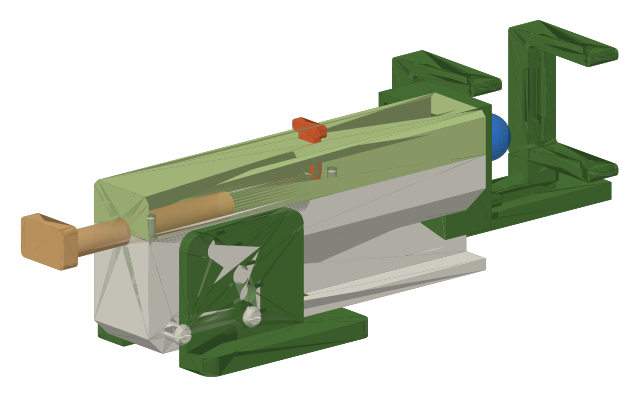
Launcher with gate barDrag to rotate · scroll to zoom
Projectile schematic
Level launch
Level launch
30° launch
30° launch
Unit 2 · Dynamics

Newton’s second law and friction

Driving question. What does a hanging mass actually do to a cart?

A cord over the pulley end piece pulls the cart (Hub docked) with a hanger of nuts. Students predict a = mg/(M+m), measure it from the encoder, find the friction force by letting the cart coast, and read it again from the intercept of (M+m)a against mg. From there: μ, and the speed lost over the run.

Hardware. Rail + pulley end + cart with Hub + mass hanger + nuts.

234 gcart + Hub system mass
0.58 → 1.94 m/s²ideal a, 2–10 nuts
≈ 0.5 m/s²coasting deceleration
5.4 gone M8 nut
Loading 3D model…
Pulley end on the railDrag to rotate · scroll to zoom
Modified Atwood setup
Free-body diagrams
Free-body diagrams
Pulley end piece
Pulley end piece
Unit 5 · Torque

Static equilibrium

Driving question. How do you weigh something with a ruler?

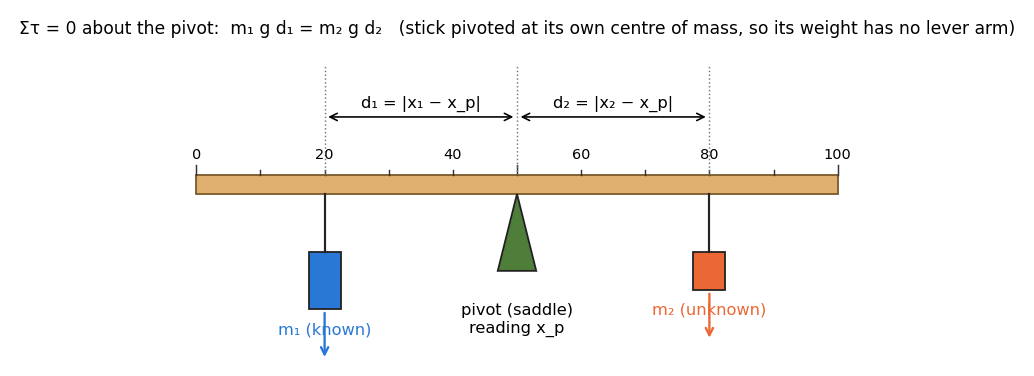
A metre stick rests on the printed pivot; students hang a known mass on one side and slide an unknown on the other until it balances, then solve Στ = 0. Moving the pivot off the centre of mass makes the stick weigh itself. A d₂ vs d₁ plot has slope m₁/m₂.

Hardware. Spring stand + torque pivot + ruler saddle + 3 clips + hangers + the student’s own metre stick.

Στ = 0balance condition
≈ 120 ga wooden metre stick
5 mmpivot above the stick’s edge
1.6 g · 3.9 gclip · hanger tare
Loading 3D model…
Torque balanceDrag to rotate · scroll to zoom
Balancing a known and an unknown
Pivot off the centre of mass
Assembled balance
Assembled balance
Unit 5/6 · Rotation

Rotational dynamics — disc spin-up

Driving question. What is the rotational inertia of a disc, and can you change it?

A hanging mass on the spool spins the platform disc while the encoder records θ(t). Students predict α from τ = Iα, measure it, plot τ against α (slope I) and compare with ½MR². Nuts dropped into the pockets at a known radius add a predictable ΔI; an energy check recovers ω after a 0.5 m drop.

Hardware. Spindle block + platform disc + encoder + pulley end + hanger.

1.16 × 10⁻⁴ kg·m²I from CAD
1.27 × 10⁻⁴½MR² for comparison
12 → 62 rad/s²α for 1–9 nuts
+3.1 × 10⁻⁵ΔI, three nuts at 44 mm
Loading 3D model…
Spindle and platform discDrag to rotate · scroll to zoom
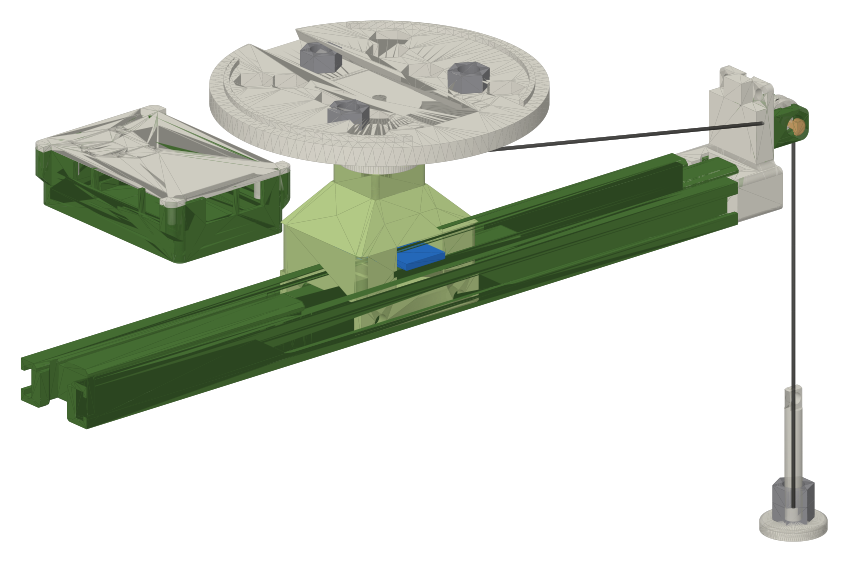
Torque from the hanging mass
Platform on the rail
Spin-up setup
Spin-up setup
Unit 7 · Oscillations

SHM — cart between two springs

Driving question. What sets the period of a mass on a spring?

Students first measure k by hanging masses from a spring on the stand. Then the cart sits between two springs on the rail; the encoder records x(t), and T² against m has slope 4π²/k_eff. The energy section compares ½kA² with ½mv²max read from the same trace.

Hardware. Three rail segments + spring ends + 2 springs + cart with Hub + stand for k.

0.555 sT with 15 N/m springs
1.31 s²/kgT² vs m slope
20 mm · 0.23 m/sA and v_max
0.612 speriod match vs PASCO
Loading 3D model…
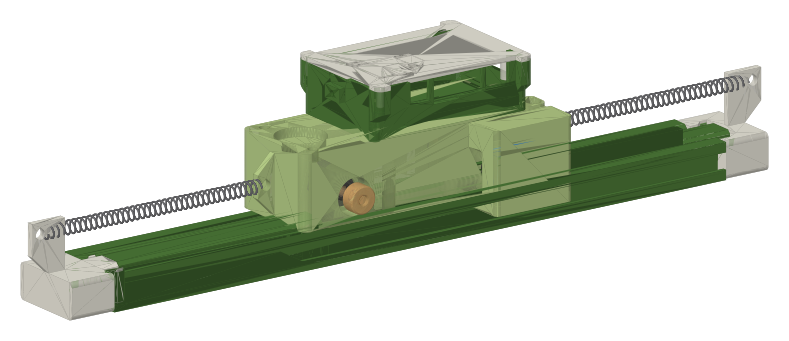
Cart between two springsDrag to rotate · scroll to zoom
Two-spring oscillator
On the rail
On the rail
k from the stand
k from the stand

Teach with it.

Handouts are CC BY-SA — edit them, rebrand them, hand them out. The kit ships with printed copies of all five.

Buy the kitOr build it yourself — free files