The runs
Three pushes, four panels each.
Position, velocity, acceleration and the velocity difference. Click any graph to open it full size; the aligned CSVs are below.
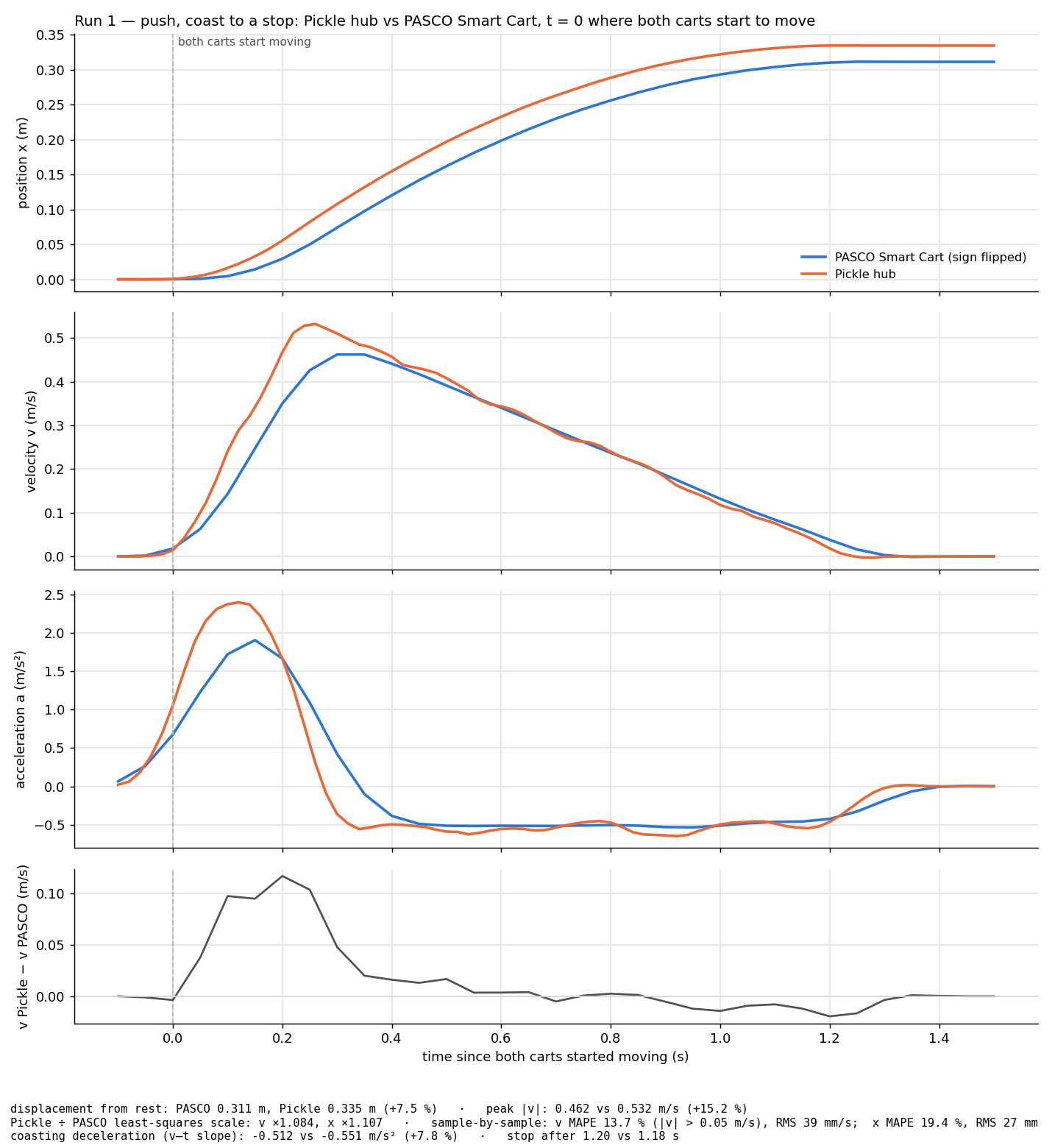

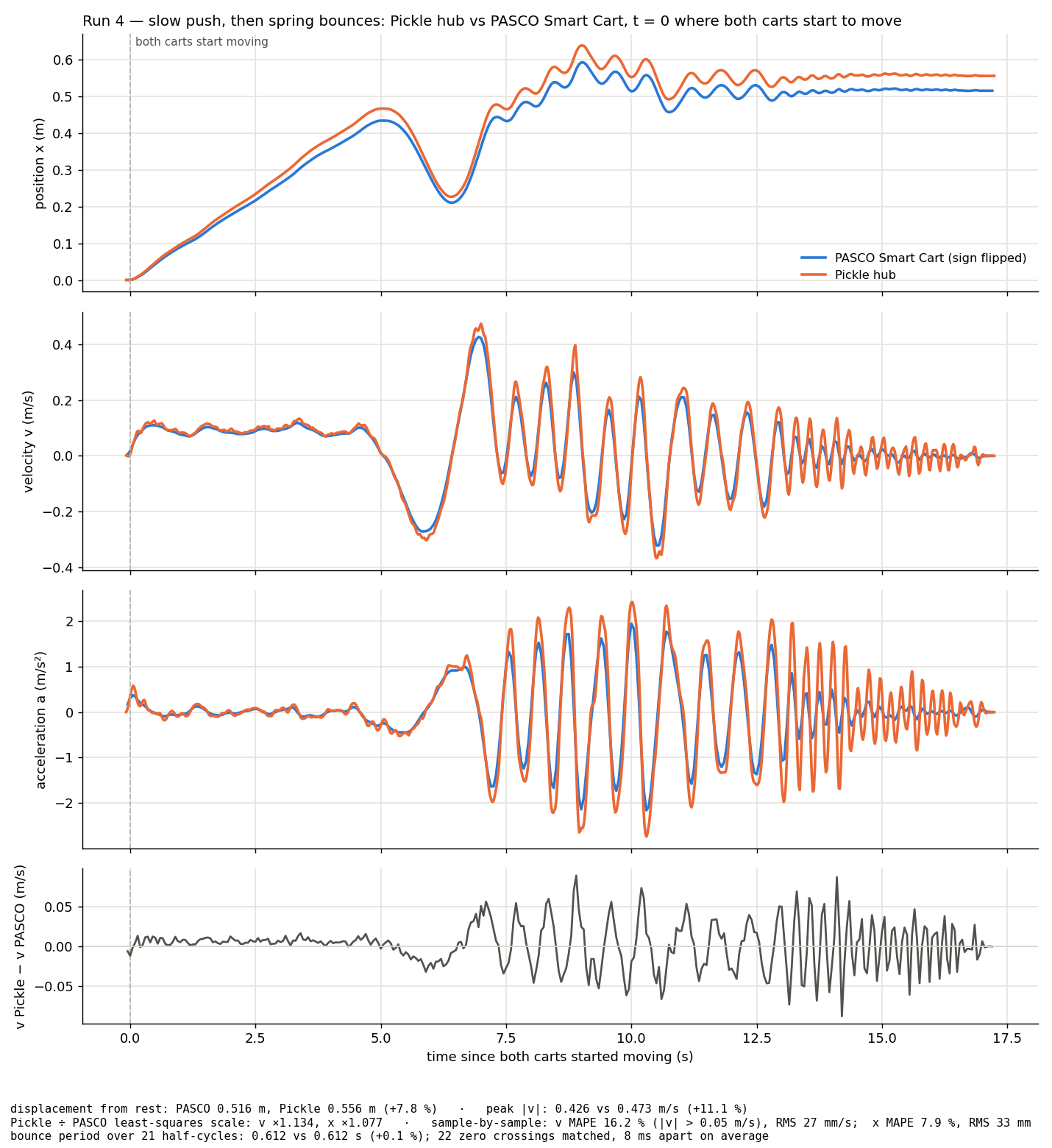

October 2026. Both carts on the same printed rail, pushed by the same hand, recorded at the same time — Pickle at 50 Hz through the dashboard, PASCO at 20 Hz through Capstone.
Method. PASCO reports position in the opposite sense, so its sign is flipped. Each run starts where both carts first move and ends 0.3 s after the later stop. Pickle data is interpolated onto PASCO's timestamps; a velocity cross-correlation confirms the alignment to within 10–35 ms. In Run 3 PASCO began recording 0.30 s after the carts moved, so that run is aligned by cross-correlation alone.
Result. Every graph has the same shape. Displacement read 7.5 %, 7.6 % and 7.8 % long — one constant, exactly what a wheel-circumference error looks like. The V-wheel rides deeper in the groove than drawn, so the effective rolling diameter is 28.8 mm rather than 31; dividing by 1.0765 brings the errors to ±0.2 % and the position RMS to 1–2 mm. The firmware default now carries the measured value. Timing needed no correction: coasting deceleration, stop time and oscillation period all agreed; PASCO's 20 Hz velocity filter accounts for the only other residual (its peaks lag by about 40 ms).
Position, velocity, acceleration and the velocity difference. Click any graph to open it full size; the aligned CSVs are below.
For a student the numbers that matter are slopes, periods and ratios, and those matched a $199 commercial cart out of the box. The one systematic difference was a known, single-valued calibration — the kind of thing a good lab asks students to find and correct, and which the kit now ships corrected.
Still open: a small twice-per-revolution ripple in velocity from the encoder magnet's centring, visible in the slow-push run, and a higher force sample rate for sharper impulse curves.
The Pickle Core kit ships printed, with every bought part in the box. Available to purchase on Shopify.